Bass imposes new limits on rebuilding process for warehouse that burned in Boyle Heights
Los Angeles Mayor Karen Bass ordered city agencies on Friday to delay the processing of rebuilding permits for the Lineage burned-out cold storage warehouse in Boyle Heights until regulators have found ways to subject the project to strict environmental review.
Read more Newsoms release tax returns. See how much the couple earned since he became governor
In an executive order, Bass said the city’s planning and building and safety departments must also determine whether the application to rebuild the Lineage facility — which was destroyed in June, leaving behind an estimated 85 million tons of smelly, rotting food — should be subjected to a lengthy “discretionary review” process.
The mayor also asked the council to approve a moratorium on large cold storage facilities in proximity to residential neighborhoods and sensitive uses, such as parks and schools.
The moratorium, depending on the actions of the City Council, can be kept in place for up to two years, according to the mayor’s team.
“They shouldn’t even think about rebuilding until they’ve cleaned up the mess they’ve created,” Bass said at a Friday news conference. “This is why I am directing city departments to put their plans up on a shelf while a thorough investigation of the property and any future use is conducted.”
Representatives of Lineage didn’t immediately comment on the order.
Bass stood in front of a display that accused Lineage of refusing to provide sufficient support to help nearby residents relocate to other parts of the city. The display also said the company had refused to address unsanitary conditions, including odors and the spread of flies and rodents into nearby properties.
Bass’ team said 3,800 complaints about Lineage have been lodged with the South Coast Air Quality Management District, which has issued 19 violation notices to the company.
The city and county secured $1.6 million for emergency housing relocation through Airbnb and housing nonprofits, sheltering more than 1,300 residents and hundreds of pets. Bass said Lineage provided only $100,000 for those efforts.
“That’s less than 7% of what we’ve provided,” she said Friday.
The mayor’s order comes after Lineage representatives filed permits with the city to rebuild the warehouse to its “pre-fire condition” Monday, drawing swift condemnation from locals and Bass, who decried the application as “a slap in the face” to Boyle Heights families.
Bass said the Friday directive will not be her last executive order mobilizing resources for Boyle Heights following the fire.
Los Angeles County Supervisor Hilda Solis said she felt like she “was in a war zone,” after visiting the warehouse site.
Solis said that she was planning to present a motion at a Tuesday Board of Supervisors meeting aimed at increasing consequences for businesses that commit public health violations, and expanding support for affected residents.
The county is also taking steps to expand access to landfills beyond normal operating hours to allow Lineage to remove noxious debris around the clock.
“We know that the money is going to run out in terms of Airbnb and providing assistance,” Solis said. “That has to come in right away.”
A day earlier, city officials announced that cleanup efforts at the Lineage cold-storage warehouse in Boyle Heights were nearing the halfway mark, six weeks after a fire at the depot left millions of pounds of rotting food to pollute the Los Angeles neighborhood.
Read more Trump administration releases long-awaited 10-year plan for dwindling Colorado River
The city’s focus is shifting from providing immediate relief to removing noxious debris, reducing foul odors and tainted air, and putting affected residents into interim housing, said Jon Brown, assistant general manager of the Los Angeles Emergency Management Department.
Lineage states the fire started during rooftop solar testing by subcontractor Altus Power. Altus has denied responsibility, stating that the cause is undetermined and accusing Lineage of finger-pointing instead of focusing on community relief.
Residents served Lineage a lawsuit seeking medical damages, noting a similar rooftop solar fire occurred at the facility in 2024.
Bass clarified that the investigation into who is responsible for the fire is still underway, but said Lineage needs to answer for what followed. She accused the company of failing to properly disclose that meat products were stored at the site to begin with, and said the company has been too slow to remove the waste.
She remains skeptical that she’ll ever allow the company to operate in Los Angeles in the future.
“It would be very hard for me to imagine the day that we would welcome Lineage back,” Bass told a Times reporter Friday.
Solis and Los Angeles City Council member Ysabel Jurado concurred with the mayor’s assessment, with Jurado going as far as to say she definitely” [wants] to stop any rebuilding permit” for Lineage.
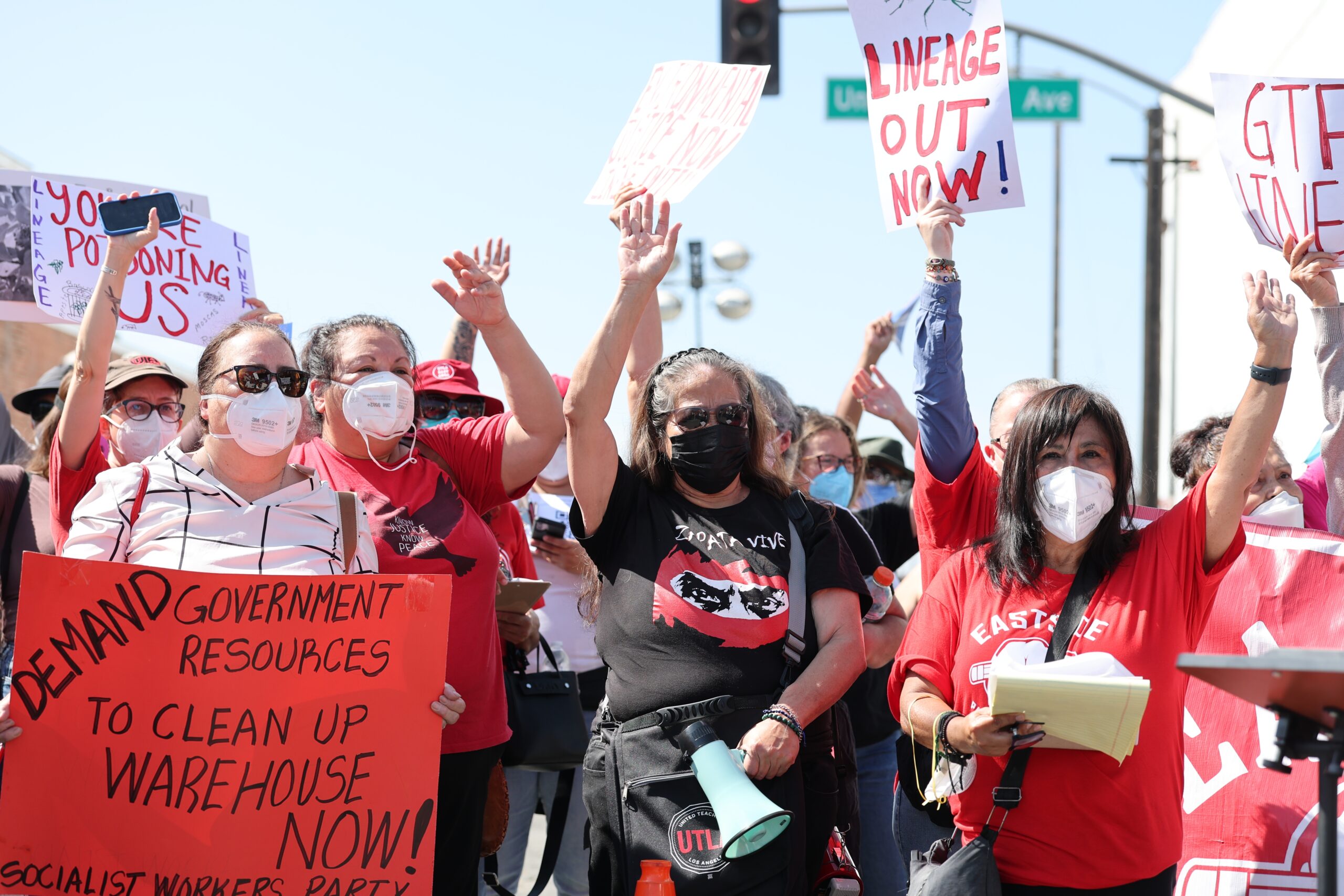
As the mayor’s news conference came to an end, Boyle Heights residents rallied outside the Lineage warehouse facility, briefly shutting down a stretch of Olympic Boulevard just north of the disaster site.
Protesters demanded Lineage’s unconditional removal from the community and said that aid from the city, county and local nonprofit organizations has dried up.
“We’re asking for Lineage to leave our community now and forever,” Estuardo Mazariegos, a candidate for City Council District 9, said at the rally.
At the protests, dozens chanted slogans, including “afuera Lineage! (Lineage out)” and toted signs reading “clean water over profits” and “you’re poisoning us.”
Many at the rally called for Lineage to pay every bill that comes out of the crisis, including waste remediation, interim housing costs and lofty medical bills. Emergency room visits for smoke inhalation and throat pain spiked following the first days of the fire, and residents want the company held financially responsible.
Antonia Montes, a resident in the area, said she was relieved that Bass was stepping up, but more needs to be done.
“I’m glad she’s now saying that she doesn’t want them here, but we’re saying, ‘what’s the plan to make sure they’re not here?’ ” Montes said. “The next step is to stop it right there and not let them renew their permit and make sure they’re gone.”
Read more California produced over half its May electricity from solar, a world record