Even business-friendly Vernon is souring against data centers
There is only one place new data centers are being built in the greater Los Angeles area: the city of Vernon.
Read more In Nigeria, solar panels are the new wedding gift
Just south of downtown L.A., it’s a city made up almost exclusively of companies. About 50,000 people commute every day into Vernon to work, but only about 300 actually live there, and the city government is famous for its friendliness to heavy industry.
Numerous surrounding jurisdictions have put moratoriums on data centers as a wave of furious opposition sweeps the nation. But Vernon has courted them, with one already operating and an additional five in the works.
Yet even here, the anti-data center winds are starting to blow.
Most development in Vernon is allowed “by right” as part of the city’s strategy to attract businesses. But at a council meeting last month, members took a step toward zoning changes that would make data centers one of the few industries to require environmental review.
“We definitely need some regulations for the data centers,” Vernon Mayor Pro Tem Jesus Rivera said at the meeting.
The first indication the city might be reconsidering its approach came last December when its public utility announced it would stop processing new requests from data centers to connect to its grid.
The subsequent zoning review was prompted by community concerns about the demand data centers place on electric systems and water supplies, emissions and noise from their backup generators, and the relatively few permanent jobs they create, city staff said.
“Even the Vernon employers, residents, businesses, those who work in Vernon,” are concerned, Chamber of Commerce president Marisa Olguin said at the meeting. “I think we should all do well to have more education and understanding about each development.”
Data centers need to be up and running 99.99% of the time, so they require backup power, usually from diesel-burning generators that emit soot, harmful nitrogen oxide and carbon dioxide. The South Coast Air Quality Management District has already approved 52 diesel generators for three data centers within a four-block radius in Vernon.
Air pollution rules allow the generators to run during grid emergencies, such as when blackouts are imminent, as well as 50 hours a year for testing.
Boyle Heights and Southeast L.A. communities such as Maywood and Huntington Park have long fought against polluting industry in neighboring Vernon, most famously with the Exide lead-battery recycling plant, which they successfully shut down in 2015.
But historically Vernon has seen very little opposition from within the city itself. The few people who live here are often employed by the city or live in city-owned housing. “It’s a company town in every sense of the word,” said Felipe Aguirre, director of Comité Pro Uno, an environmental justice nonprofit in Maywood. “People don’t want to say anything.”
But data centers are changing that.
The Los Angeles Unified School District, the second-largest in the country, has weighed in. It is fighting a data center planned for across the street from Vernon City Elementary School. Demolition at the site is already underway.
The school district has repeatedly asked Vernon to block the construction of Texas-based Digital Realty’s 217,800-square foot project until it goes through a full environmental review, according to letters reviewed by The Times.
“It’s about being informed about the potential impacts of a development near one of our schools,” Deputy Supt. Pedro Salcido said in an interview, citing a desire to know more about noise from the facility, pollution from any generators, and dust from demolition and construction.
Read more President Trump backs energy permitting bill on eve of Senate vote
The authors of a UC Riverside report last year estimated that the health cost of running data center backup generators in California was approximately $ in 2023, about a third of that coming from the Los Angeles region.
VCES, the only school in Vernon, sits at the loud and busy intersection of South Sante Fe Avenue and East Vernon Avenue surrounded by a paper mill, warehouses, cold storage facilities, manufacturing and other heavy industry. Its K-6 classrooms serve 144 students with special needs, most of them Latino.
Just down the block, Prime Data Centers’ 242,500-square-foot facility has permits for 20 diesel generators and draws up to 49.5 megawatts, enough to serve more than 26,000 homes for a year.
Vernon and Digital Realty say the new data center next to the school is permitted by right under city zoning, which means it doesn’t have to go through any formal environmental review process.
In response to questions about the project’s backup generator plans, Digital Realty spokesperson Richard Hartnett said the company has “worked hard to communicate openly and transparently” with the city, the school and other community stakeholders “to understand concerns and identify opportunities to reduce potential impacts associated with construction activities.”
City spokesperson Diana Figueroa said the developer has requested 49 megawatts of power.
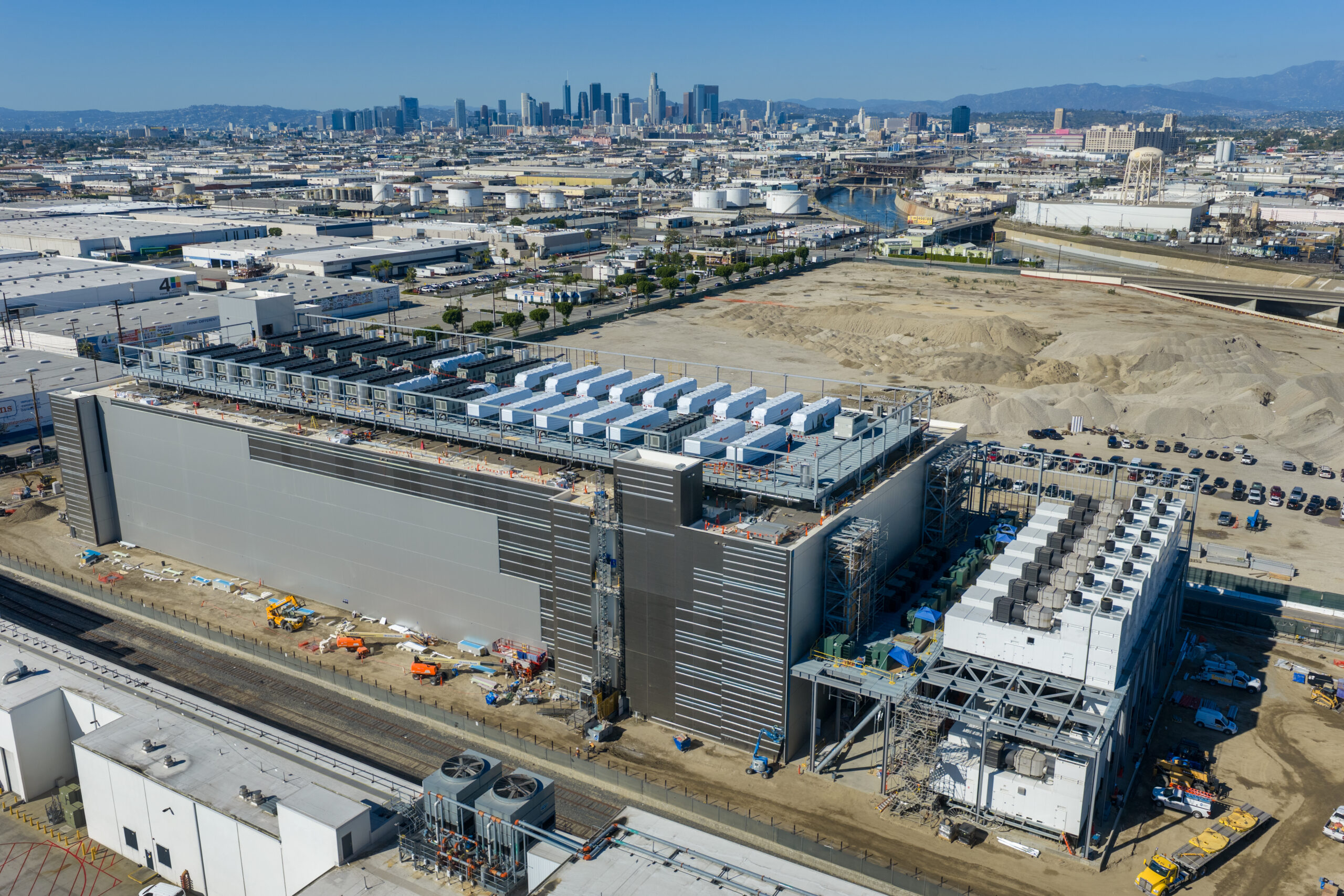
The other four centers being developed are an approximately 50-megawatt one by CoreSite Real Estate under construction a half mile from VCES at Vernon Avenue and Alameda Street, a 49-megawatt project planned by SCIND Fruitland Point LLC for its warehouse site at 2761 Fruitland Ave., and two large projects by Goodman Group by the L.A. River at Vernon Avenue and Soto Street. One of them, another nearly 50-megawatt project that appears to be almost complete, expects to start operation in February.
The other, the massive 99-megawatt Goodman Energy Park, is planned for the site of the former Farmer John slaughterhouse and is seeking to exempt 40 diesel backup generators from the California Energy Commission’s regulations on small power plants, which would bring the city’s approved data center generator count to 92.
“Vernon’s current approval process does not protect people’s health,” said Vanessa Vasquez, a volunteer lawyer with Communities for a Better Environment, an environmental justice group in the area.
The City Council will hold a public hearing Nov. 17 to consider subjecting any future data centers to public environmental review and development agreements with the city. A vote would be scheduled for Dec. 15.
If council members approve it, they’d be overriding the recommendation of their own Business and Industry Commission. Industry perspectives at the October meeting were split.
Miles Solomon, an industrial Realtor and member of the BIC, advocated for turning Vernon into California’s equivalent of data center-friendly Loudoun County, Va., and imposing a new tax on data centers, rather than permitting requirements. “This is such a golden opportunity for Vernon to capture new business and to collect new revenue,” he said.
Brian Baley, another member of the BIC who manages the Pabco Paper plant next to the planned Digital Realty site, advocated for the city to adopt the zoning change, “to control some of where Vernon’s going.”
Read more U.S. midterms bring new focus to weather and science in Washington