Panama’s environment chief says ‘petroleum mafia’ holds climate talks hostage
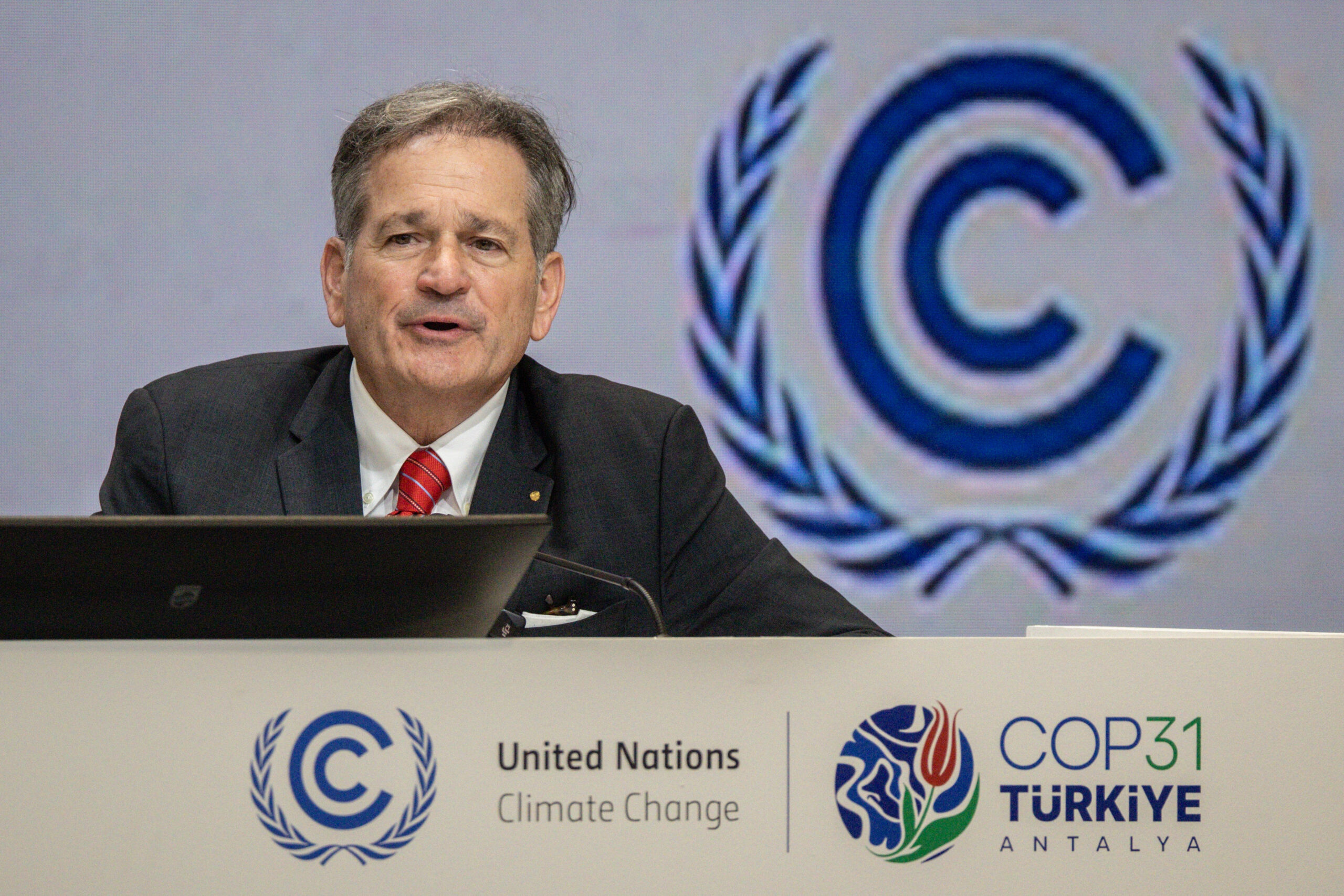
Panama’s environment minister said negotiations at COP31 in Turkey are being held hostage by a “petroleum mafia,” in one of the summit’s harshest attacks on fossil-fuel-producing countries.
Read more Climate talks ditch call to quit fossil fuels as deal nears
“We are in love with our kidnappers,” Juan Carlos Navarro said sardonically, likening governments’ continued dependence on oil, gas and coal to Stockholm syndrome. “They torture us for our own good. They destroy our planet for our own good. They destroy nature to help us.”
His speech at a news conference Wednesday at the annual climate talks in Antalya drew a rousing reception and quickly became a talking point around the summit.
Navarro was speaking alongside representatives of vulnerable small island nations pressing for a legally binding international treaty to curb coal, oil and gas production. The group wants governments to halt new fossil-fuel expansion, coordinate an equitable phaseout of existing production and provide financing to help developing economies diversify and protect workers and communities through the transition.
“Climate change is a risk to our very survival as a nation,” Navarro said. “For Pacific nations, this isn’t another agenda item. This isn’t a game for us.”
Backers of the proposed Fossil Fuel Treaty, including Vanuatu, Tuvalu, Fiji and Panama, say it would close a gap in the international climate framework. While the Paris Agreement requires countries to submit plans for cutting emissions, it doesn’t directly coordinate limits on the production and supply of the fuels driving global warming.
Read more California’s first carbon storage project keeps operating under legal challenge
Navarro disagreed with the idea that global temperatures may temporarily exceed the Paris Agreement’s 1.5 degrees Celsius, or 2.7 degrees Fahrenheit, threshold before later being brought back down, a scenario known as an overshoot. “I kill you now, but maybe in a few years you may resurrect. Yeah, sure. Now tell me another one,” he said. “We already blooped up by the 1.5. It’s probably irreversible.”
He also criticized oil-producing countries for failing to provide enough money to help vulnerable nations withstand climate damage.
“Oh, and those lovely petroleum-producing countries,” Navarro said. “They’re so generous, except they don’t give one dime for adaptation or for facing the climate crisis or for saving biodiversity.”
The minister called for “radical change of course” in climate action and urged countries to act with urgency as the summit draws closer to its end.
Read more Magnitude of U.S. data center pollution estimated as climate talks address AI
Usmani writes for Bloomberg.