Climate talks ditch call to quit fossil fuels as deal nears
Negotiators at the annual United Nations climate talks dropped calls to accelerate a phase out of fossil fuels while heading toward an endorsement of efforts to electrify the global economy.
Read more California’s first carbon storage project keeps operating under legal challenge
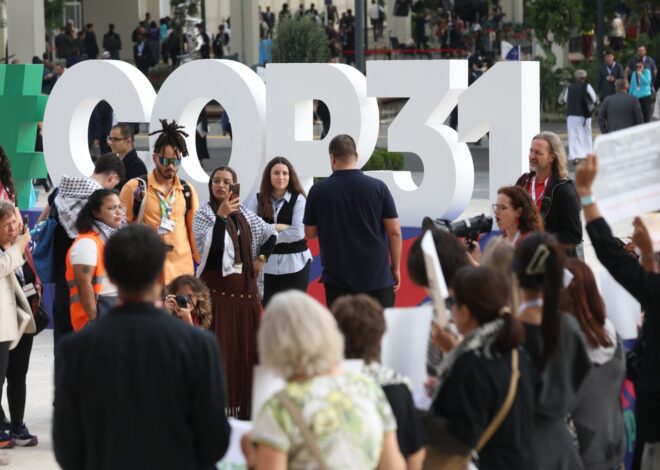
A draft decision text released Thursday offered potential compromises on charged issues, including climate finance, trade curbs and the timing of some key science reports, boosting the chances for the COP31 talks in Antalya, Turkey to reach agreement on a broad deal among almost 200 nations.
The outline said countries recognize the benefits of electrification to reduce emissions and improve energy security, paving the way for an increased focus on moving sectors such as transportation and heavy industry away from the use of polluting fuels.
While the text was whittled down to nine pages, half the size of an earlier draft, the latest draft leaves negotiators with significant work still to do. Ministers and negotiating blocs resumed deliberations Thursday and prepared to work through much of the night, with talks likely to extend beyond Friday’s scheduled close.
“We have an obligation to make COP31 a success,” Murat Kurum, Turkey’s environment, urbanization and climate change minister, and the summit’s president, told reporters Thursday. “We will not leave the negotiating table until the solution has been reached.”
The new draft strikes a softer tone on the oil and gas sector, and shifts decisively away from aggressive earlier proposed wording that called for “accelerated action to phase out fossil fuels,” and an “immediate transition” in energy systems.
Envoys abandoned explicit references to curbing releases of methane pollution by energy producers, and embraced an industry-backed push to accelerate the use of carbon-capture technologies — frequently seen as a distraction from action to cut emissions.
The retreat on fossil fuels at the summit came hours after the leaders of the U.S., China and Russia agreed to boost the supply of refined petroleum products as wars strain oil and gas flows.
Nations advocating climate action while also pursing deals on polluting fuels risk undermining global efforts, said Nana Antwi-Boasiako Amoah, chair of the African Group of Negotiators on Climate Change. “This is a hypocrisy in the whole process,” he told reporters.
Organizers of the summit have been working to build support for a voluntary pledge to boost electricity’s share of global final energy demand to 35% by 2035, from just over 20% currently. They are also seeking to include the goal in the final COP31 declaration, which would put the ambition on a more formal footing.
That’s drawn stiff objections from a bloc of developing countries, including India, that oppose enshrining top-down targets in a formal decision. Negotiators aimed for a compromise in the latest text by combining the objective with references to earlier pledges to boost renewable energy and accelerate efficiency gains.
Read more Magnitude of U.S. data center pollution estimated as climate talks address AI
The new proposed text reflects attempts to deliver the strongest language possible at a conference where deals are forged only through consensus, said Chris Bowen, Australia’s climate change and energy minister, who is acting as president of negotiations. Discussion will continue until the summit can send “a message as strongly as it needs to be to the boardrooms and living rooms of the world,” Bowen told reporters.
Nations meeting in Antalya for two weeks are under pressure to deliver a decisive response after a year of deadly extreme weather disasters and a bleak UN assessment that the world won’t fulfill its Paris Agreement pledge to limit the increase in global temperatures to 1.5C, a key threshold for planetary warming.
Critics accused Turkey and Australia of prioritizing the electrification target at the expense of important work to unlock climate finance and decarbonize.
“The attempt to prove that a flashy headline target signals success for this COP has gone wrong in many ways,” said Avantika Goswami, a program manager for the Centre for Science and Environment India, a research group.
While a plan to triple adaptation finance by 2035 is included in Thursday’s draft text, an earlier proposal that called for the delivery of at least $120 billion a year has been removed. Developing countries are estimated to need about $305 billion annually for adaptation by 2035, according to the UN Environment Programme.
Instead, details on the issue could be decided at next year’s COP32 meeting in Addis Ababa, Ethiopia, with the draft laying out a potential roadmap to identify predictable and larger sources of adaptation finance.
Trade has proven a contentious issue in negotiating halls, and an initial proposal for the phase out of unilateral measures — such as mechanisms that tax cheaper goods produced under weaker environmental rules — was removed in the latest text. China, the world’s leading exporter of green technology, has pushed for the free flow of the products.
Negotiators are still trying to resolve a dispute over the timing of upcoming reports from the Intergovernmental Panel on Climate Change, which some nations want published in time to inform a “global stocktake,” an assessment of the world’s progress toward Paris Agreement goals.
Kenya, India and other countries have raised concerns about completing the analyses on a compressed schedule, while some argue the process tilts in favor of wealthy nations. The new draft agreement advances a potential compromise by offering a less explicit timetable.
Read more Plastic producers face scrutiny after half fail to report data required by California law
Dlouhy, Ainger, Usmani and Pike write for Bloomberg.