Water from Boyle Heights warehouse fire carries foam into L.A. River, sparks testing
LOS ANGELES — All the water unleashed onto the warehouse fire in Boyle Heights — some of it 480 gallons at a time by helicopter — had to end up somewhere.
Read more L.A. finally reaches a deal for recovering its Olympic costs
That somewhere is the Los Angeles River.
Los Angeles Fire Department crews ripped through 50-foot walls filled with foam insulation to get to the building’s steel skeleton and its storage racks.
Charred chunks of foam have been floating from the burn site, partially blocking storm drains. Now organizers from East Yard Communities for Environmental Justice are teaming up with scientists from UCLA and Columbia University to find out more about what’s in the runoff.
“The community here is really interested in knowing, ‘Are there any contaminants that are potentially making their way down to the L.A. River?’” said Yoshira “Yoshi” Ornelas Van Horne, UCLA assistant professor in environmental health sciences. “We really can’t answer that unless we actually have measures and samples analyzed.”
Water samples collected directly from the warehouse fire runoff have been shipped to Columbia‘s Multi-Element Trace Analysis Laboratory in New York, which has a spectrometer that can identify trace levels of elements. The lab also has relationships with researchers in Southern California.
The data will then come back to UCLA for analysis. For now, the scientists and community advocates only have the money to test for copper, lead and arsenic, Ornelas Van Horne said. Residents have expressed interest in testing for more contaminants.
As the water from the firefighting efforts trickles through the warehouse in rivulets, it forms a stream at the corner of S. Indiana and Noakes streets, that gushed into the storm drain. On a recent visit, the water traversed a smoky 10-foot canyon of charred foam and twisted wall panels on its way to the drain.
From there, the water flows to the L.A. River. Despite the fact that its concrete design is intended to whisk water out of the city as fast as possible, life stubbornly persists in the river and nearby. Recreational swimming is not permitted, yet anglers fishing for tilapia, largemouth bass and carp are a common sight along the rocky sides of the soft-bottom areas.
The L.A. River, and all it carries with it, meets the ocean in Long Beach.
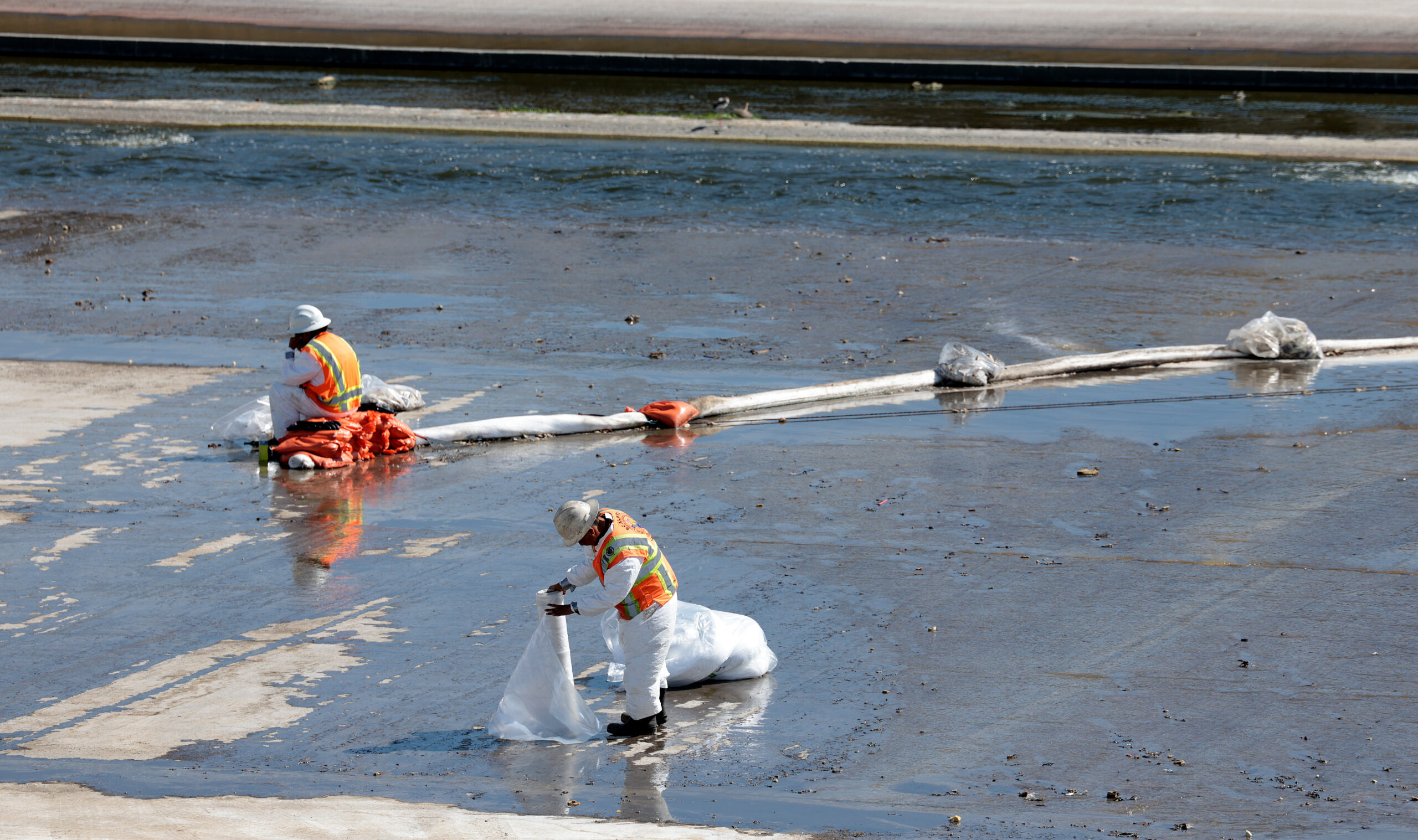
The L.A. County Public Works Department said it has deployed three containment booms — floating barriers — on the L.A. River, and is continuing to monitor the water as it makes its way to the ocean.
Before it gets there, the river passes through the Dominguez wetlands, where Public Works is removing some number of dead fish. The wetland has absorbed toxic runoff from a warehouse fire before, resulting in a fish die-off.
Read more Quicker count, bigger turnout: L.A. County certifies 2026 primary election ballots
“For so long, the L.A. River has been used as a dumping ground for all kinds of chemicals,” said Emmanuel Carrera Ruedas, a community scientist and member of East Yard Communities for Environmental Justice.
Pollution has plagued the L.A. River, but it does have allies. In the 1980s, the Friends of the LA River pushed to address street runoff and trash that had made the water body infamous. Significant progress from advocacy and government initiatives improved water conditions, but these efforts have not been equally distributed.
Carrera said the samples represent “proof of what’s actually going on, and accountability, too, for the city, of not just what’s happening in our air, but what’s actually happening in our waterways.”
The first samples for the project were taken last Friday, the second day of the fire.
They were the first of 20 samples the research groups have agreed to test at no cost to see if any exceed regulatory standards and could pose a risk to people nearby.
The warehouse fire represents the latest environmental disaster for people in Boyle Heights and East L.A. Just four weeks ago, a telecommunications crew accidentally struck one of the many oil pipelines beneath the L.A. area, spilling 25,000 gallons of crude oil near Eastern and Cesar Chavez avenues — including into storm drains feeding to the L.A. River.
“I think it really is difficult to see disaster after disaster hit the communities here, with not a lot of talk about how we can move through these disasters together,” said Casey Cooper, a volunteer community scientist involved in the sampling. They were inspired, they said, by the response of neighbors, and how people were supporting one another.
Results from the laboratory analysis could be back to Ornelas Van Horne within a month.
Read more Newsom, California Legislature reach $351.7-billion budget deal
