A competitive governor’s race? Not only in California
WASHINGTON — As Californians cast their ballots in the state’s closely watched gubernatorial primary Tuesday, a very different race was playing out in Iowa — one that holds clues about the mood of Republican voters heading into November.
Read more One thing was clear on election night: Angelenos want change
President Trump’s endorsed candidate in Iowa’s high-stakes governor’s race, Republican U.S. Rep. Randy Feenstra, lost his bid for the party’s nomination, a rare defeat for a Trump-backed candidate.
The outcome exposed fractures among Republican voters, though their choice of Zach Lahn, who ran on an “Iowa First” and Make America Healthy Again platform, didn’t amount to a rebuke of Trump’s politics, said Jimmy Centers, a Republican strategist in Iowa.
The primary race was “emblematic of the seismic plates that make up the Republican Party in Iowa,” Centers said — the successful MAGA-style message, from Lahn; a more traditional conservative platform, from Feenstra; and a conservative Christian approach, from candidate Adam Steen.
“It’s a bit of a look-ahead in terms of how the Republican Party is going to be shaped in what will be a post-Trump era,” Centers said. “Those plates are moving, and last night in Iowa, we had an earthquake.”
Results from Iowa, California and other late-stage primaries portend contentious fall campaigns, with control of the House and Senate hanging in the balance.
“You’re seeing Republican primary voters rebel against politicians, whether it’s Dusty Johnson in South Dakota or Chip Roy in Texas,” said Matt Gorman, a longtime Republican strategist and chief communications officer at Targeted Victory. “There’s clearly a backlash against sitting politicians, and Republican primary voters are looking for outsiders.”
That pro-outsider outlook has been promoted by Trump himself in some races, as he has used his endorsement to boost primary challengers to victory over Republican incumbents — notably in Texas, Louisiana and Kentucky. In Tuesday’s primaries, however — held in six states — none of the races involved Republican veterans whom Trump wanted to see ousted.
Outside of such races, Trump — who last week said, “I don’t care about the midterms” — has taken a more laissez-faire approach. In Iowa, he did not endorse Feenstra until Friday, a last-minute boost that didn’t help the congressman over the finish line.
Lahn, in a victory speech Tuesday night, acknowledged the upset he had pulled off.
“Nobody thought this could be done,” Lahn said. “We were outspent, opposed by the establishment, told to wait our turn.”
Lahn will face Iowa state auditor Rob Sand, who ran uncontested for the Democratic nomination. The seat is being vacated by Gov. Kim Reynolds, a Republican who is not seeking reelection.
Iowa Republicans will now ramp up efforts to retain both the governor’s office and the U.S. Senate seat being vacated by Sen. Joni Ernst, as Democrats target both offices for flipping.
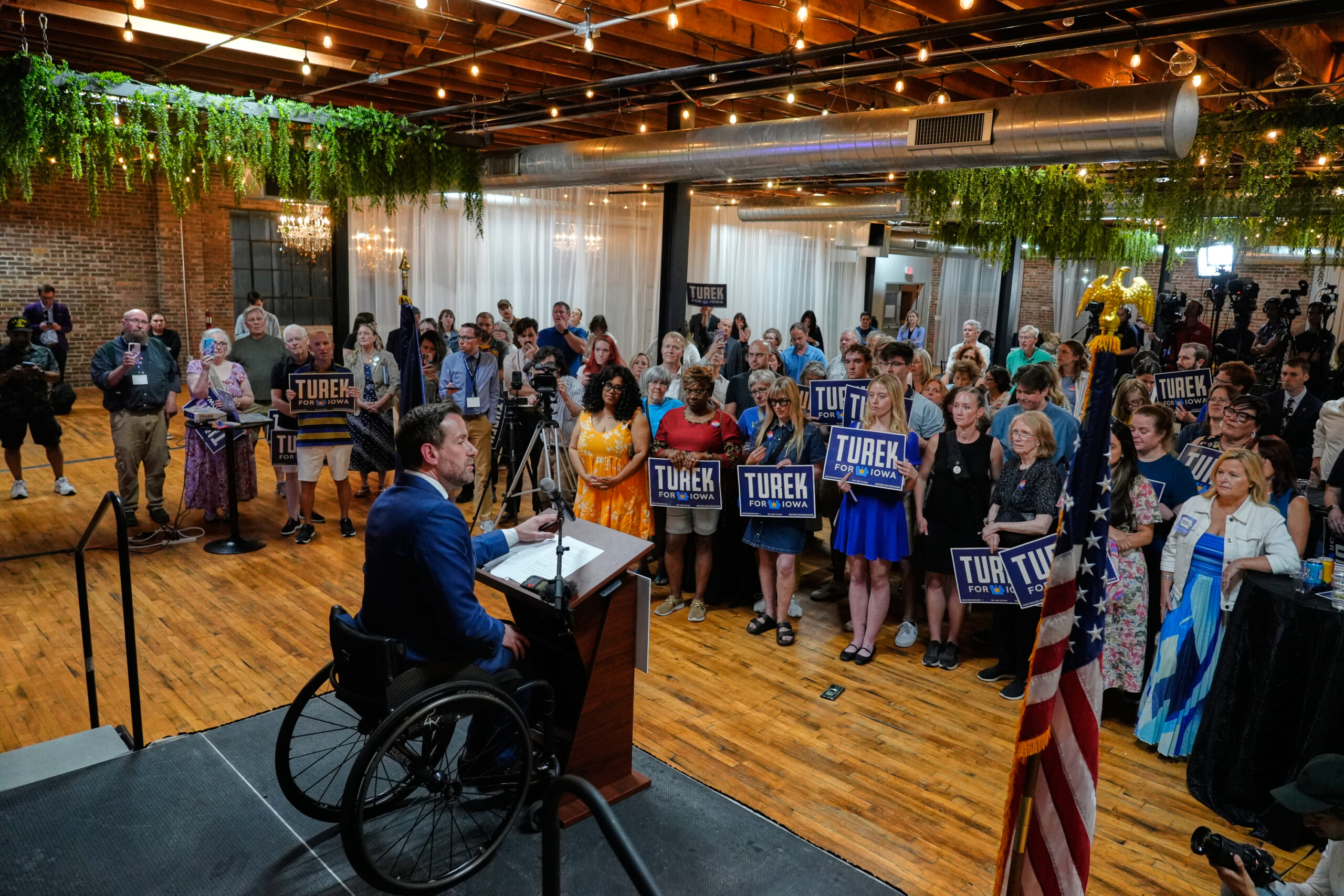
The race to replace Ernst is now on between Republican Rep. Ashley Hinson, who has been in Congress since 2021 and has Trump’s support, and Democratic state Rep. Josh Turek, a former Paralympian who was backed by a leadership PAC aligned with Senate Minority Leader Chuck Schumer.
Read more In race for Pelosi’s seat, her famed political influence was a factor — but just one
Economic issues, particularly in the agricultural sector, where farmers have been squeezed by Trump’s tariffs and war in Iran, could dominate the races. Centers said both parties are acutely aware of the economic factors — and aware that Democrats’ chances in Iowa could be slightly better than “a hope and a prayer,” though the state’s voter-registration edge remains solidly red.
“I don’t think many Republicans in Iowa are bashful about acknowledging the environment we’ll face in November,” Centers said. “It’s going to be a hard-fought race.”
Other Tuesday takeaways
Elsewhere on Tuesday, voters chose candidates in races for U.S. Senate, House and governor’s seats, setting up some lively November match-ups.
In New Jersey, the state’s 7th Congressional District will be a closely watched contest — largely because of the recent absence of Republican Rep. Tom Kean, who has not been publicly seen for months as he deals with an undisclosed medical issue.
His absence has provided an opening to Democrats, who have ramped up attention on the seat as they attempt to flip as many House seats as possible. Rebecca Bennett, a former Navy helicopter pilot, won the Democratic nomination Tuesday.
Kean, who has support from Trump, ran unopposed. In a statement Tuesday evening, he laid out plans to reveal his medical condition when he returns to in-person work, which he said would be “within a matter of weeks.”
The race could become key to Democrats’ attempt to win control of the House in November.
“We’re ready for this fight. Bring it on,” Bennett wrote Wednesday on X.
In Montana, the race for the state’s open U.S. Senate seat, being vacated by Republican Sen. Steve Daines, was also set to get interesting.
Trump-backed Republican Kurt Alme, a former U.S. attorney, and Democrat Alani Bankhead, an Air Force veteran, won primaries Tuesday — but former University of Montana president Seth Bodnar has launched an independent bid for the seat. Bodnar said Tuesday that he had delivered enough petition signatures to the secretary of state to get on the November ballot.
And in New Mexico, former Interior Secretary Deb Haaland secured the Democratic nomination for governor, advancing in her bid to make history as the first Native American governor in the United States. She will face Republican Gregg Hull, a former local mayor, in November.
What’s next
Next week brings Maine’s Senate primaries, following a Democratic race that has taken several twists and turns. Democrats have held hopes of unseating Sen. Susan Collins, the veteran Republican lawmaker, as part of their long-shot attempt to flip the Senate along with the House.
But leading Democratic candidate Graham Platner has been dogged by controversies. The primary vote will be held just more than a week after a New York Times report that he had sent sexual messages to several women outside his marriage. This week, Gov. Janet Mills, who had opposed Platner but suspended her campaign at the end of April, said, “I am still on the ballot.”
Also to watch: Next week’s outcomes in South Carolina’s crowded gubernatorial field; the June 16 Georgia Senate runoff to determine which Republican will face Democratic Sen. Jon Osoff; and the June 16 Democratic primary for Senate in Oklahoma.
Read more Youth, money, gender and other takeaways from California’s crazy gubernatorial primary
Times staff writer Michael Wilner,in Los Angeles contributed to this report.