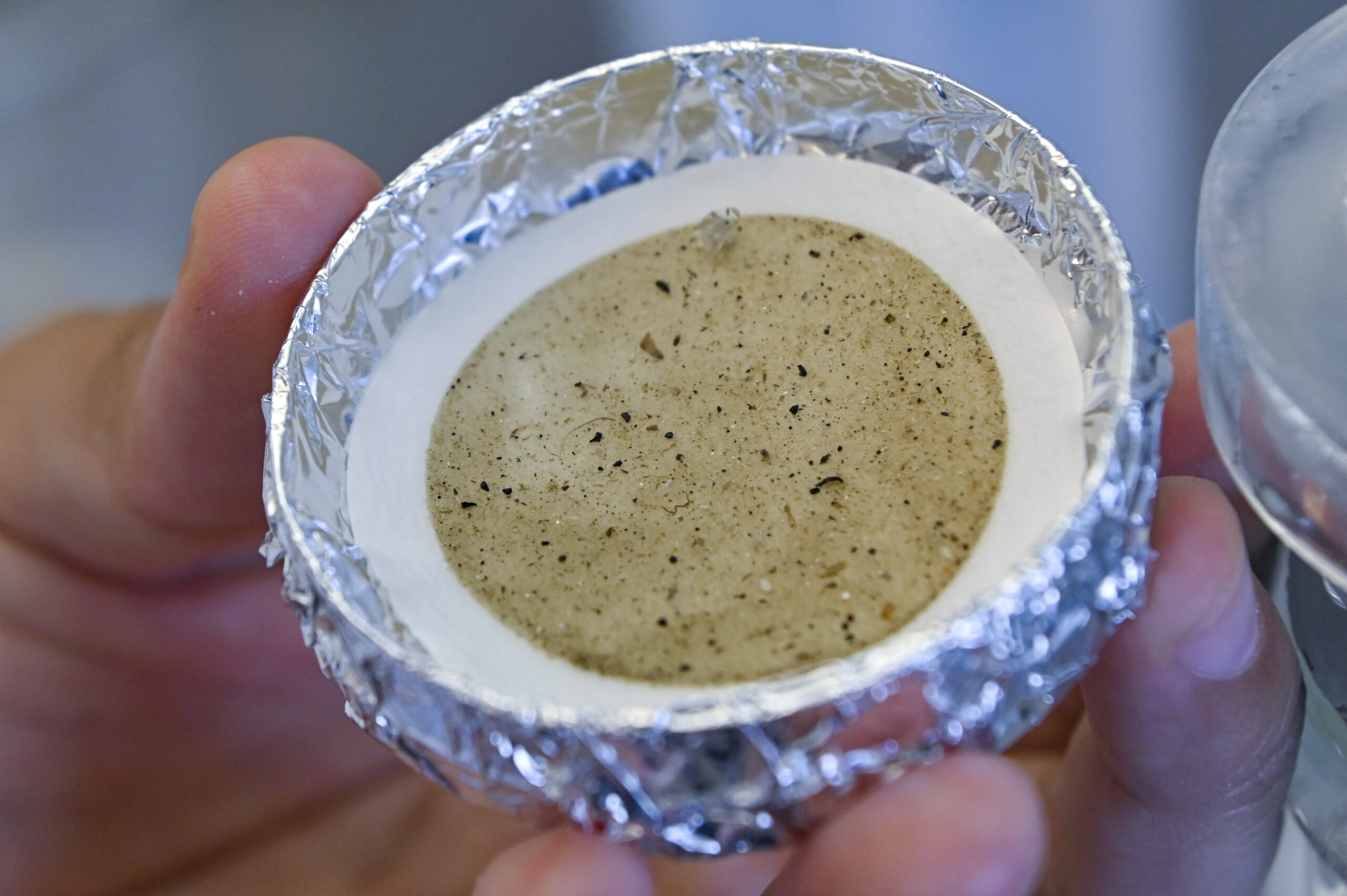
Industry executives knew for decades about microplastics
Scientists today say we’re just beginning to understand the harm that the tiny bits of plastic we drink, eat and breathe are doing to the human body.
But recently discovered chemical company documents dating back several decades show that industry scientists have long been aware of — and concerned about — the way microplastic particles migrate beyond the gut in animals and humans, depositing in important organs. And the potential for that knowledge to affect the plastic food packaging industry.
Their concern goes back to 1974 and a scientific meeting at a New York City hotel, where a German gastroenterologist presented a scientific paper that showed for the first time that ingested particles like microplastics could infiltrate the rest of the body.
His presentation was largely overlooked by the government scientists in attendance but became a point of worried discussion among company scientists.
A “horror story” was how one company executive described how that research was received.
The word “microplastics” had yet to be coined, but the Berlin researcher Gerhard Volkheimer showed that tiny bits of swallowed plastic PVC could slip through the intestinal lining of animals and travel through the blood and lymph to the brain, liver and other internal body parts.
According to Matthew Campen, a professor of pharmaceutical research at the University of New Mexico, and a leading researcher in microplastics and human health, the same process applies to any small, impermeable particle including polyethylene, polypropylene and PET — the plastics that dominate today’s market and the microplastics found in human bodies.
The presence of these particles in human bodies has been linked to heart disease, inflammation and cancer.
Internal memos among company scientists and executives obtained by The Times reveal that for at least half a century, the plastics industry has been aware of and concerned about the potential for microplastic contamination in the human body.
Tracey Woodruff, professor of epidemiology and population health at Stanford University, who reviewed the documents, said they indicate scientists and executives at major chemical companies have known and remained silent even as microplastics accumulated in tissues. She likened it to other industries that knew about pollutants — greenhouse gases, asbestos and tobacco — but did not take action to make them safer.
A spokesperson with the chemical industry’s largest trade group took issue with that characterization.
“Scientific debate over what the evidence shows is not silence. It is how sound science and effective policy advance,” said Craig Davis, senior director of plastics chemistry at the American Chemistry Council. “Our industry is committed to advancing microplastics science by supporting independent research and policies that would do so.”
He said the trade group has supported a congressional bill that would “improve scientific methods and enable ‘gold standard’ science” on microplastics and pointed to its funding of the Microplastics Advanced Research and Innovation Initiative, founded in 2022 by the International Council of Chemical Assns.
The Plastics Industry Assn. did not respond to requests for comment.
A seminal meeting
In 1974, Irving Selikoff, a renowned toxicologist and physician at the Mount Sinai School of Medicine, hastily convened a meeting of toxicologists, labor representatives, health officials and industry executives hosted by the New York Academy of Sciences — one of the oldest independent scientific organizations in the country. Selikoff had exposed the dangers of asbestos a decade earlier.
This meeting was to address an urgent workplace issue.
Three months earlier, a physician at the B.F. Goodrich Co., a manufacturer of PVC plastics, had identified a cluster of workers at a Kentucky factory who had come down with a rare and deadly form of liver cancer, angiosarcoma. Other cases in West Virginia, New York and Pennsylvania soon followed. Federal agencies and the plastics and petrochemical industries scrambled to respond.
The National Institute for Occupational Safety and Health and the Environmental Protection Agency were both new, created only in 1970. They had few scientists on staff and no track record of research; they lacked the data needed to evaluate an unfolding disaster, let alone control it.
At the time, PVC and vinyl chloride monomer — the raw ingredient of PVC — were used in a variety of household and industrial items, and deemed safe by regulators and manufacturers. PVC was being used to make food packaging as well as water pipes. Vinyl chloride — which is typically in a gas form — was used as a propellant for hair spray, spray paint and pesticide.
“Everybody considered it safe, and so this came as a shock,” said Henry Falk, former assistant surgeon general and now adjunct professor at Emory Rollins School of Public Health in Atlanta, who was at the meeting. The outbreak shattered “the illusion of safety for these types of chemicals.”
At the time, Falk was a young investigator at what was then called the Center for Disease Control. He also helped identify the clusters and solidify the evidence tying the chemical to the deadly liver cancer.
Of the 289 participants at the conference, a third were from industry — Dow Chemical, Exxon Corp., Monsanto and others — and the rest were from the federal government, labor, academia, scientific societies, nonprofits and consulting firms.
Philip Landrigan, one of the world’s preeminent microplastic researchers, a pediatrician, and director of Boston College’s Program for Global Public Health and the Common Good, was there. He was 32 and also working at the Center for Disease Control.
He doesn’t remember much from the meeting, other than it drew people from around the world — Japan, Sweden and Romania — and there was an urgency in the air.
He has no memory of Volkheimer’s presentation. Neither does Richard Lemen, also at Emory, and former assistant director of NIOSH. Nor does Falk.
For the three young scientists, it was the star power that made an impression: the renowned toxicologists and oncologists, and the epidemiologist who first linked smoking to health problems, Sir Richard Doll.
Volkheimer was the final speaker in the session “Toxicological Investigations of Vinyl Chloride-Polyvinyl Chloride; B. Experimental Studies.” The researcher, who published mostly in German, presented his work on a physiological process known as persorption.
He’d been conducting research at Berlin’s Charité — one of Europe’s oldest and most prestigious university hospitals — and showed that solid particles move across the lining of the gut when ingested, then into the rest of the body. Since the 1950s, he’d been feeding animals and occasionally humans small particles of potato and corn starch, iron flakes, rolled oats, pollen and PVC.
He performed his experiments on dogs, pigs, goats, rats, guinea pigs, rabbits and chickens. For the purposes of this meeting, he highlighted the studies in which he’d fed them microscopic PVC particles.
Within two hours of ingestion, he found the particles moved to the lymph system, blood and organs, including the brain, liver, lungs and muscle tissue. He also found little PVC flakes in cerebrospinal fluid — the watery liquid that flows through and around the brain and spinal cord — as well as breast milk.
He confirmed the particles crossed the placenta. Caffeine and nicotine increased the speed and volume of the movement across the gut. So did sleep. They also moved faster in younger creatures.
He used potato starch as a proxy in humans, having shown in previous studies that it behaved similarly to PVC.
Read more Trump wants to strip California of coastal protections unless state meets list of demands
Volkheimer called them microparticles or just “PVC particles.” The term “microplastics” was not coined until 2004, when a British researcher described small plastic particles he was finding in the waters off the coast of the United Kingdom.
And although the young government investigators who were there don’t remember the speech, executives at several chemical and plastic companies took note.
Ripples inside an industry
In the weeks, months and years that followed, plastic, chemical and fossil fuel companies referred to the presentation and discussion, according to documents reviewed by The Times. The records, most produced by companies during lawsuits over tobacco, asbestos and industrial chemicals, are publicly archived in the UC San Francisco Industry Documents Library and in ToxicDocs, a project of Columbia University and the City University of New York.
On May 17, 1974, an executive at the Firestone Plastics Co. — a division of Firestone Tire and Rubber Co. — penned a about the meeting to company President Todd Walker, and said “that when PVC (not VCM) was fed to animals, it was retained by various organs.” VCM is the initialism for vinyl chloride monomer.
Shell Oil Co.’s manager of industrial hygiene, Howard Kusnetz, sent of the meeting to the company’s medical director, Roy Joyner, and others. Kusnetz knew the federal side well: Until 1971 he had been an assistant director of NIOSH, before Shell hired him to build its industrial hygiene program. “Volkheimer claims these particles were also found in the cerebrospinal fluid of dogs,” he wrote. “Volkheimer noted that it takes four minutes for the starch to appear in the blood after ingestion, with a peak at 10 minutes.”
In a to fellow executives at Union Carbide, the petrochemical giant later bought by Dow Chemical, the company’s assistant director of safety complained that the Volkheimer paper had “been cited often as a ‘horror story’ on ingesting PVC resin.”
To counter it, he pointed to a 1947 industry-sponsored Harvard University study in which animals fed flakes of a PVC-like plastic, called Geon 202, did not get sick. He said the study supported “the use of PVC in food packaging” and would “offset some of the damage done by the Volkheimer paper.”
The industry continued to cite Volkheimer’s research internally throughout the 1970s, ‘80s and ‘90s, other documents show. The Chlorine Institute commissioned a titled the “Interpretive Evaluation of the Potential Human Health and Environmental Effects of Vinyl Chloride and Polyvinyl Chloride.” In it, the consulting firm CanTox used Volkheimer’s research to show that this common plastic could potentially be absorbed by the body and build up inside living tissues over time.
For decades, the industry’s own documents indicate it was concerned about Volkheimer’s findings that plastic particles could pass from the gut into the blood and lodge in the body’s tissues. Today, as scientists report finding those particles in human arteries, placentas and brains, the industry’s leading trade groups emphasize what they describe as substantial gaps and quality problems in the research, and say more study is needed before conclusions can be drawn about human health.
Davis, from the chemical trade group, for example, said Volkheimer’s research and experiments did not show that “real world exposure to microplastics causes harm” to humans.
“The media is moving faster than the science on this issue,” Ross Eisenberg, president of America’s Plastic Makers, a division of the American Chemistry Council, said in a 2025 paid advertisement in the Washington Post. “Our view is we need to let the science lead.”
Pharmaceutical industry takes notice
With health officials so focused on the issue of cancer and workers, Volkheimer’s paper slipped into relative obscurity in the worlds of toxicology and public health. It was cited in a 1975 EPA Scientific and Technical Assessment report.
“We were concerned with fatal disease in workers,” said Falk, recalling conversations with employees and their families in a dozen trips to Louisville, Ky.
Later that year, the Occupational Safety and Health Administration slashed the amount of vinyl chloride a worker could breathe from 500 parts per million to one part per million.
After that the knowledge mostly disappeared, with the exception of one field: : pharmacology. Drugmakers seized on persorption as a way to understand how medicines are absorbed in the gut, and by the 1990s, pharmaceutical scientists considered particle uptake established enough to design products around it.
In 2003, Volkheimer’s work was cited in a California asbestos and drinking water report, and began to be referenced in marine biology and environmental toxicology papers.
It appeared in two reports from the World Health Organization, in 2019 and 2022.
Woodruff, who was school age at the time of the meeting, went on to serve as senior scientist and policy advisor in the EPA’s Office of Policy between 1994 and 2007, before joining UCSF. Now at Stanford, she said she thinks another reason the research was largely overlooked by public health officials and academic toxicologists for so many decades may have been because most of Volkheimer’s work was published in German.
“I think even our systematic review on microplastics … I think we only focused on English-language articles,” she said, referring to a 2024 report.
Campen, the University of New Mexico microplastics researcher, suspects people at the time could not fully understand the implications of the findings.
“Nobody knew that plastic degradation was going to be a problem when he did this work,” he said. Volkheimer “was literally using this as just a model to show that, yeah, the gut can really take up plastic particles or any kind of particle potentially.”
“In retrospect, we thought we had solved a huge problem by making it safe to produce these plastics,” Falk said. “The last thing in our minds was that we were going to drown the world in plastics 50 years later — that that was going to be our future.”
Davis, however, questioned the relevance of Volkheimer’s work, noting the German, who died in 2021, fed his animal subjects between 100 and 200 grams of PVC daily. The equivalent in an adult human, he said, is about 650 grams, or 1.5 pounds. In published work at the time, however, Volkheimer noted his human subjects were fed the same 100 and 200 grams of the proxy potato starch, and the starch ended up in the blood and breast milk.
A heated area of research
Today’s researchers have benefited little from the work until now. Campen, reviewing it, described the study as well done and said his lab has “somewhat parallel findings” — in even smaller particles — that he has not yet published.
Modern microplastics research began in 2018, when scientists at the University of Vienna discovered the pieces in people’s feces.
Since then, they’ve been found in blood, breast milk, semen, lung tissue, heart tissue and brains.
For Davis, however, the evidence suggests the “risk to consumers from microplastics is relatively low,” and although research should continue, “it is important to note that the presence or movement of particles within the body does not by itself establish harm, causation or risk.”
Yet their presence has become concern enough among health officials, lawmakers and researchers that in 2018, California passed a law requiring the state’s water agency to define, test for, and report the particles in drinking water. The Trump administration, averse to most regulation, announced earlier this year that the EPA would begin tackling them in drinking water as well.
When Volkheimer made his presentation, Campen said, there was just so much less plastic. “Now we’re in a situation where we can find evidence of this all over the planet.”
This article was done in collaboration with Crooked Ideas, which provided reporting support.
Read more Critics blast California’s $180-million water buy as ‘extraordinarily expensive’

Related Posts
Idealism vs. affordability: How high gas prices and Trump forced Newsom to recalibrate his climate agenda
Trump wants to strip California of coastal protections unless state meets list of demands