Wildfires and extreme rain are filling U.S. reservoirs with dirt
Turn on a hose in Denver this summer and the water likely flows from the Strontia Springs Reservoir. The small manmade lake in the mountains just west of downtown stores the state’s precious snowmelt and distributes it through the dry months, when rain grows scarce and farmers are irrigating frantically.
Read more EPA seeks more public comments as it struggles to devise water rule that limits scope on wetlands
But over its 44 years, Strontia has lost much of its ability to store water. The reservoir is now almost one-fifth full of sediment — sand, silt and mud.
Most of the country’s 90,000 or so storage reservoirs are facing a similar problem. These dams are in a self-propelling sediment loop. Climate change is exacerbating drought and wildfires, destroying plants that hold soil in place.
More extreme rainfall is unleashing torrents of water and debris, as happened in the flash flood that killed two people and washed away bridges and trails in the Grand Canyon last month.
The same fossil fuel emissions that are intensifying this cycle are crimping water supplies. This winter, the American West got less snow than ever recorded, sapping the Colorado River and driving water levels at the country’s two largest reservoirs to record lows. Last month, the federal government ordered California, Arizona and Nevada to sharply curtail the amount of water they draw from rivers and reservoirs over the next two years. Precisely when water officials need to stockpile water to last through longer dry spells, sediment is robbing them of the space to store it.
At Strontia, for example, a rash of wildfires between 1996 and 2008 scorched the canyon upstream. Without healthy trees and brush, the steep banks shed sand into the lake in every rainstorm, said Erin Gleason, a dam safety engineer with Denver Water, the city’s utility. Strontia wasn’t large to begin with, she notes, and it’s shrinking at the worst possible time.
Denver — like much of the American West — has spent the summer under emergency drought protocols. Yet a mound of muck that would fill 700 Olympic-size swimming pools now displaces four days’ supply of water.
That means the water utility has to rely increasingly on distant reservoirs upstream, many with sediment problems of their own. And if Strontia fills up too much, Denver won’t be able to send water to its largest treatment plant.
“We’re looking at all kinds of ways of getting sediment out of the reservoir,” Gleason said. “It’s the biggest concern we have in our system.”
The country has lost an estimated 8% of its water storage capacity, the equivalent of 25.5 million Olympic-size swimming pools, according to a study published this week in Nature. What’s more, nearly half of U.S. reservoirs are more than one-quarter full of sediment.
The erosion of rock into sand and silt is an unstoppable process, with rivers pumping the muck like blood vessels until it settles on beaches or deltas.
But there’s nothing natural about gigantic dams, and the engineers who built them knew sediment would probably be their demise. Every dam in the United States, when constructed, was given an estimated lifespan — generally 50 to 100 years — largely based on how quickly sediment was expected to stack up behind the concrete.
Hydrologists and dam engineers describe sediment as a slow-motion car wreck. Since the average U.S. dam is about 64 years old, the wreckage has been building up.
“It’s kind of a silent sleeper and it’s emerging to become kind of a bigger issue than it’s been in the past, mainly because things are aging,” said Sean Smith, principal hydrologic and hydraulic engineer for the U.S. Army Corps of Engineers, a federal agency that manages about 480 dams. “It’s just that, you know, there’s only so much money to go around.”
At the moment, the Elephant Butte Reservoir, a massive body of water that irrigates many of the crops in southern New Mexico, is nearly one-quarter filled with sludge — or at least, it was seven years ago, when the government last completed a public survey. New Mexican farmers who rely on the reservoir have seen their irrigation allotments slashed, according to the National Oceanic and Atmospheric Administration.
Recent research by BMO Financial Group, a Montreal-based bank, shows even a small crimp in the flow of irrigation leads to tens of millions of dollars in agricultural losses at the county level. In the 2015 drought, for example, California farmers spent an pumping groundwater as their reservoirs and ditches ran dry.
At the same time, water stress is driving up the cost of insurance for crops and livestock, which translates to higher food prices. And it’s increasing borrowing costs for water utilities.
“It’s a huge problem,” said Toby Minear, a hydrologist at the University of Colorado. “And we just keep kicking the can down the road.”
Read more Supreme Court rebuffs Missouri’s push to use new U.S. House map backed by Trump in November
There’s even less comprehensive data on the country’s 88,000 smaller facilities, generally managed by utilities, local governments and private landowners.
“When you look at reservoirs getting very, very full of sediment, they are often small reservoirs, often privately owned,” said Melissa Foster, a geomorphologist at the Bureau of Reclamation, the federal agency that manages hundreds of the nation’s biggest reservoirs.
Even fairly low sediment levels are alarming, said Aaron Hurst, a geomorphologist who left the Bureau of Reclamation in 2024. The outlet of a reservoir, including hydroelectric infrastructure, is usually closer to the bottom than the top, so sediment typically doesn’t have to rise very high before it shuts down a water resource entirely.
“The average is not a very scary, sexy number,” Hurst said. “But the part people don’t account for is it may only take 15% to block an intake. That’s the ballgame.”
That’s what has happened at the Paonia Reservoir, which irrigates a vast spread of fruit orchards west of Colorado ski country. By 2014, sediment had built up to and around the outlet, which originally was 70 feet above the reservoir’s bottom. Managers had to drain the lake and manually dig out some of the muck.
A decade later, Paonia was once again about one-quarter full of sediment. In dry years, farmers nearby have taken to ripping up immature fruit trees so their most productive stock survives.
Getting rid of sediment is a tricky and expensive endeavor. One of the most effective approaches is to flush it out of a reservoir by releasing a surge of water through the dam. But with water levels near historic lows in much of the country, opening dams to flush the dirt and mud is often a nonstarter.
Dredging can work too, but then there’s the question of where to put the silt; it can be toxic — loaded with bacteria or heavy metals — and permits to dispose of it can be hard to come by.
Given the crisis in some reservoirs, there has been a growing push to at least measure the scale of the problem.
The Army Corps of Engineers has built a database to collect all relevant sediment statistics in one place.
Even in his retirement, Tim Randle, an engineer who led the sediment group of the Bureau of Reclamation, is pushing his former colleagues to tackle sediment more aggressively. Among other things, he’s calling for a consistent national policy to manage reservoirs for long-term sustainable use and a thorough “exit strategy” for eventual decommissioning of dams, including cost estimates.
But those expiration dates could come sooner than expected, as climate change worsens the flow of sand and silt. By 2041, wildfires will double sediment accumulation in more than one-third of U.S. watersheds, according to a study by the U.S. Geological Survey.
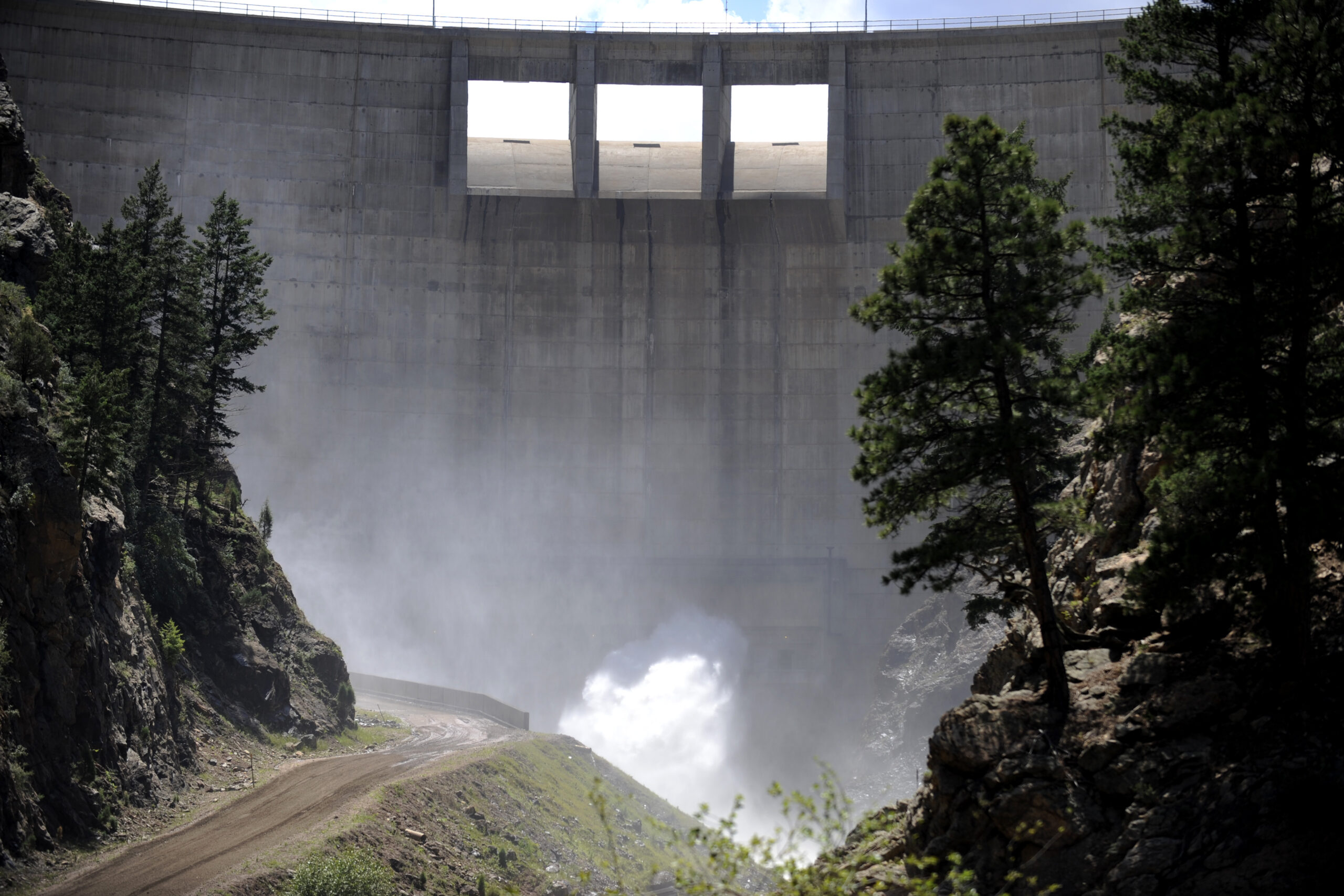
Then there’s the question of where the sediment happens to fall. In Strontia Springs, a small mountain of fine sediment has built up along the wall of the dam itself, with a hole in the middle where water flows through to the dam’s power generator. Andy Skinner, who operates Strontia’s hydroelectric facility, is concerned that at any minute a chunk of sediment could break loose and be sucked through the hole, destroying the turbine like a bird in a jet engine and leaving about 600 Denver homes without electricity.
In 2011, when 13% of the storage capacity was occupied by sludge, Denver Water started dredging. The utility spent $18.5 million to suck up some of the muck and pipe it six miles down the canyon. But much of what was removed was not the fine silt around the dam.
“The material was so coarse, it kept burning up the booster pumps,” Skinner said. “And the material was so abrasive that it would scour holes in the pipes.”
Utility crews ended up clearing out less than half of what they had hoped to.
At the same time, Denver Water started a program to thin trees to reduce wildfire risk upstream, hoping to slow erosion. Given the current drought, wildfire risk is back in the “high to extreme” range this summer — and Strontia sediment levels have nearly doubled again.
Read more Gov. Gavin Newsom’s former chief of staff seeks to delay sentencing because of health issues
Stock and Kim write for Bloomberg.